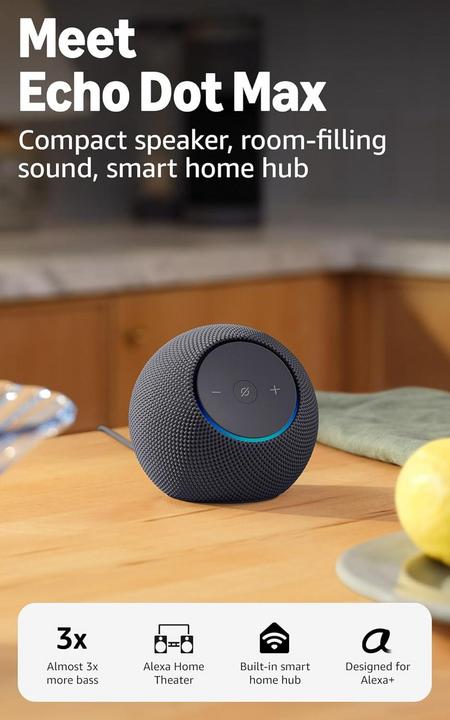
The Amazon Echo Dot Max packs surprisingly big sound into a small body, delivering room-filling sound and clearer bass.
It also includes a built-in smart home hub and eero built-in to extend Wi-Fi, plus Alexa+ for more natural voice responses.
Setup is simple, the size fits nightstands or desks, and physical mic controls give useful privacy options.

Key features of Amazon Echo Dot Max
The Echo Dot Max pairs a compact footprint with louder, fuller sound and built-in smart-home networking so one device can both play music and act as a home hub.
Those specs matter because they determine how the speaker performs in real spaces (bass fullness, voice pickup across a room), how it integrates with lights and locks, and whether it can also improve your home Wi‑Fi without a separate router.
- Audio hardware: 3″ long-throw woofer + twin 1″ silk dome tweeters (acoustic tuning for enhanced midrange and tighter bass). Designed for room‑filling sound from a compact enclosure.
- Power output: Class‑D amplification delivering roughly 30W total output (enough for medium rooms and casual parties).
- Smart-home hub: Built-in Zigbee and Thread support plus Matter compatibility for local control of lights, locks, sensors, and more.
- eero built‑in: Integrated eero mesh extender capability lets the device act as a Wi‑Fi access point to improve coverage without buying a separate eero unit.
- Connectivity: Wi‑Fi 6 (802.11ax), Bluetooth 5.3 for audio streaming, and a USB‑C power port; no internal battery—designed for plugged‑in use.
- Voice and AI: Alexa with on‑device Alexa+ processing for common requests and faster responses, plus multi‑language support and improved natural speech recognition.
- Microphones & privacy: Array of far‑field microphones with wake‑word detection, a dedicated physical mic mute button, and an indicator LED showing mic/camera status.
- Display & controls: Subtle front LED display for time/notifications, capacitive touch volume and playback controls on top, and a textured fabric grille for a premium look.
- Form factor & colors: Small footprint made for nightstands and desks (roughly a 4–5″ diameter), fabric-covered top available in Graphite, Amethyst, and Glacier White.
- Multiroom & pairing: Stereo pairing with another Echo Dot Max or compatible Echo, support for multiroom audio and Amazon Music HD, Spotify Connect, and AirPlay‑like casting via Bluetooth.
- Setup & app: Fast setup through the Alexa app with on‑device prompts; stores local routines for basic automations even if cloud connection drops.
Who this actually helps: buyers who want a compact bedside or desk speaker that still delivers stronger bass and fuller sound than a regular Echo Dot, while also acting as a smart‑home hub and improving mesh Wi‑Fi coverage via eero integration.

Pros
-
Room‑filling sound from a compact body: the Echo Dot Max uses a 3″ long‑throw woofer and twin silk‑dome tweeters with Class‑D amplification (~30W) to deliver fuller mids and tighter bass than a standard Dot, making it suitable for bedrooms, offices, and small living rooms.
-
Built‑in smart‑home hub with Zigbee, Thread, and Matter support lets the device control lights, locks, and sensors locally, reducing the need for extra bridge devices and simplifying automations for users who want direct, reliable control of their smart home gadgets.
-
eero built‑in Wi‑Fi extender improves coverage without buying a separate eero unit, letting the Dot Max act as a mesh access point to fill dead spots and boost signal on the same network—especially useful in medium‑sized homes where a single router struggles.
-
Faster voice responses and privacy controls via on‑device Alexa+ processing and far‑field microphones provide quicker replies for common requests, while a physical mic mute button and LED status indicator offer clear, simple privacy controls users can trust.
-
Compact, practical design fits nightstands and desks, with a subtle front LED display for time/notifications, touch controls, and stereo pairing support for two units—combining convenience and expandable sound in a small footprint and multiple color options.
Cons
-
No internal battery—the Echo Dot Max requires a constant power connection via USB‑C, so it cannot be used as a portable speaker or moved around the house without access to a power outlet.
-
Not a party powerhouse: about 30W output is ideal for medium rooms but can struggle to fill large, open‑plan spaces or loud gatherings; bass is improved versus a standard Dot but still limited compared with full‑size home speakers.
-
eero integration limitations—while handy for extending Wi‑Fi, the built‑in eero functionality won’t replace a dedicated eero router for advanced mesh features or heavy network management, so power users may still need additional hardware.
-
Cloud dependence for advanced features: on‑device Alexa+ speeds up basic requests, but many advanced skills, routines, and third‑party integrations still rely on Amazon’s cloud services and will degrade if connectivity is lost.
-
Basic display and controls: the front LED only handles time and simple notifications; users who want a richer visual interface or full touchscreen controls will find the display limited.
My Personal Impressions
I got the Echo Dot Max for my living room and was immediately impressed by how much sound it packs into such a small footprint. The bass is rich, mids are clear, and it genuinely fills medium rooms. It’s compact and stylish, but you sometimes have to speak up if music is loud.
The smart-home perks sold me: the built-in temperature sensor makes routines real — it can trigger a fan or AC — and Matter compatibility helped stabilize my shades. Setup was mostly painless and grouping devices is seamless. Be warned though: Wi‑Fi in remote rooms can cause hiccups and I once had to relocate it to finish setup.
Alexa+ feels like a real upgrade — follow-ups and context handling are noticeably better and it answers many everyday questions fast. That said, Alexa+ can be inconsistent: it sometimes repeats errors, mispronounces names, or needs a reboot. Also the indicator light faces forward, so from behind you can’t always tell if it heard you.
I’d buy these again — they make daily life easier and the display for time and weather is handy at night. Protection plan is worth considering because some older Dots in reviews failed after a couple years. Overall, great value for bedrooms and medium spaces; the purple color looks surprisingly nice.

Extra: Tips, Comparisons, and Real Use Cases
Optimizing sound placement
Place the Echo Dot Max on a stable surface away from walls and corners to avoid boomy bass. The speaker uses a 3″ long-throw woofer and twin 1″ silk-dome tweeters, so leaving 2–6 inches of clearance behind the unit helps keep bass tight and mids clear.
For small bedrooms or desks, position the Dot Max at ear level and orient the speaker grille toward your listening area. If you need wider coverage, pair two units for a true stereo setup, which separates left and right channels and improves imaging more than just increasing volume.
Setting up smart-home and eero features
Use the Alexa app to enable the Echo Dot Max as a hub: add devices under the smart-home section and follow prompts for Zigbee, Thread, or Matter device pairing. Local control reduces latency for lights and locks and keeps basic automations running when the cloud is slow.
Turn on eero built-in in the device settings if you want the Dot Max to act as a mesh access point. For best results, place the Dot Max roughly halfway between your router and the Wi‑Fi dead zone; it can extend coverage but won’t fully replace a dedicated eero router in large homes.
Real everyday use cases
Bedside use: the Dot Max doubles as a useful alarm and audio source—its front LED display shows time and notifications while its improved bass gives podcasts and music a fuller sound without taking up much space.
Home office: place the device on a desk to use it for voice calls, music, and quick routines. Its on-device Alexa+ processing speeds up basic queries, and the physical mic mute button gives simple privacy control during work hours.
How it compares to earlier Echo Dots
Compared with a standard Echo Dot, the Dot Max offers noticeably stronger low end and higher overall output thanks to its larger woofer and ~30W Class‑D amp. You’ll hear fuller mids and bass that a regular Dot can’t reproduce at similar volume levels.
Unlike older Dots, the Echo Dot Max also includes a built-in smart-home hub and eero integration, combining three functions (speaker, hub, Wi‑Fi extender) into one device—this reduces clutter but may not replace dedicated high-end speakers or full mesh systems for advanced needs.
About Amazon and the Echo Line
Amazon began as an online bookseller and expanded into hardware with the Echo line, first launching Echo in 2014. The Echo brand has focused on bringing voice control to homes while integrating tightly with Amazon services and third-party smart-home vendors.
The Echo family emphasizes broad compatibility: newer models add support for Thread and Matter to improve interoperability across ecosystems. Amazon also iterates frequently on audio and AI features to balance price, functionality, and ecosystem value.
Amazon’s approach is to merge services and hardware: features like on-device processing (Alexa+), privacy controls, and eero integration reflect the company’s aim to make devices both useful and integrated. That makes Echo devices attractive if you already use Amazon services or want a single vendor for voice, smart-home, and basic network extension.
Amazon Echo Dot Max — Frequently Asked Questions
What is the Echo Dot Max and how does it differ from a standard Echo Dot?
The Echo Dot Max is a compact Alexa speaker tuned for louder, fuller sound with a 3″ woofer, twin tweeters and ~30W amplification. It also adds a built‑in smart‑home hub (Zigbee/Thread/Matter) and eero mesh extender capability, so it combines speaker, hub, and Wi‑Fi extender in one unit.
How good is the sound for music and podcasts?
Sound is noticeably fuller than a regular Echo Dot with tighter bass and clearer mids, making it great for bedrooms, offices, and medium rooms. It’s not a replacement for large floorstanding speakers or party systems, but it outperforms other compact Echo models.
Can I use the Echo Dot Max as a portable speaker?
No. The Echo Dot Max requires a constant power connection via USB‑C and has no internal battery, so it’s designed for stationary use on a desk, nightstand, or shelf.
Will the built‑in smart‑home hub work with my existing devices?
Yes. The Echo Dot Max supports Zigbee, Thread, and Matter, which covers a wide range of lights, locks, sensors, and plugs. Many devices can pair directly to the Dot Max, reducing the need for separate bridges, though some proprietary products may still require their own hub or app.
What does eero built‑in actually do — can it replace my router?
eero built‑in lets the Dot Max act as a mesh access point to extend Wi‑Fi coverage and reduce dead spots, which is helpful in medium homes. It won’t fully replace a dedicated high‑end router or a full eero system for advanced routing, heavy traffic, or very large homes.
How does the Echo Dot Max handle privacy and voice data?
The Dot Max offers a physical mic mute button and an LED indicator to show mic status, plus on‑device Alexa+ processing for basic requests to speed responses locally. However, many advanced skills, third‑party services, and complex routines still rely on Amazon’s cloud, so those features need an internet connection.

Conclusion: Is Amazon Echo Dot Max Worth Buying?
If you want a single, compact device that combines better-than-Dot audio, local smart-home control, and simple Wi‑Fi extension, this conclusion explains who should buy it.
We recommend Amazon Echo Dot Max for people who need room‑filling sound from a compact speaker (3″ long‑throw woofer + twin 1″ tweeters, ~30W), a built‑in smart‑home hub with Zigbee/Thread/Matter for direct device control, and eero built‑in to extend Wi‑Fi coverage without buying a separate mesh node.
If you want integrated audio, hub, and network features in a small, plug‑in device, the Echo Dot Max is a practical choice.